Russia's trade with Africa remains small and concentrated in a few countries, according to figures cited by DW Europe. Russian customs data show total trade with all 54 African countries came to about $27 billion in 2025, or 3.9% of Russia's foreign trade. Egypt accounted for around 39% of that trade, at $10.5 billion, mainly Russian grain and metal products.
Ivan Klyszcz of the International Centre for Defence and Security in Tallinn says South Africa, Africa's largest economy, trades far less with Russia than with Egypt and Algeria. He says Russian diplomats and businesses have tried to expand ties with Tanzania and Ethiopia "with no appreciable success so far."
Egypt is building a nuclear power plant at El-Dabaa, financed by a Russian loan of $25 billion that covers about 85% of costs. Nikita Smagin, an expert on Russian Middle East policy, says Egypt could become Moscow's gateway to Africa in the long term. He adds that Cairo is pursuing its own interests and that it would be too optimistic to assume Egypt backs Russia purely out of political solidarity.
The report says the European Union is Africa's most important trade partner, with about $385 billion in trade in 2025. Trade with China exceeded $348 billion, with the United States nearly $105 billion, and with India $103 billion.
Fidel Owusu of Geopolitical Intelligence Services in Liechtenstein says Russia's economic footprint in Africa is far smaller than China's, the United States', India's, or those of former colonial powers France and Britain. Beverly Ochieng of Control Risks says Western countries still dominate raw material extraction, finance, and energy, though their political presence is declining. She expects Russia to compete more for critical minerals and energy projects, citing lithium projects in Mali and nuclear initiatives across the continent.
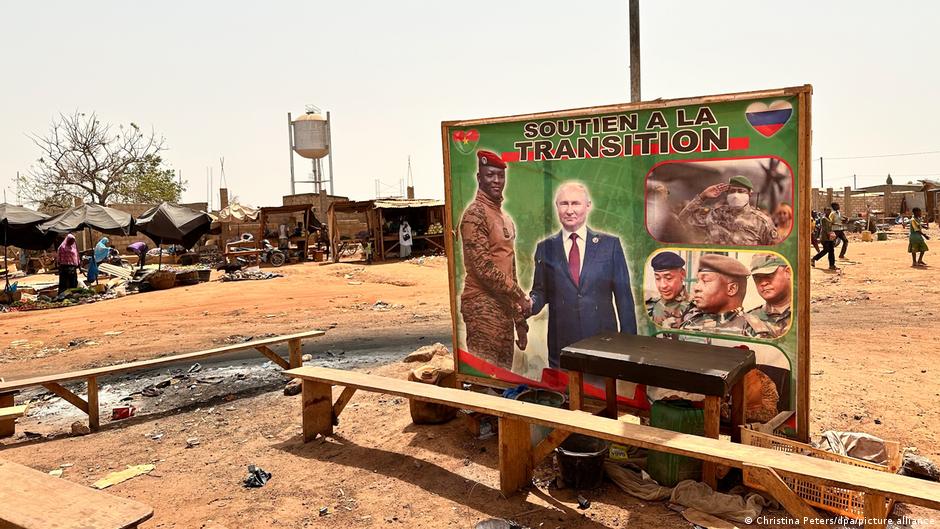
Russia's most visible presence is military. The report says Russian mercenaries have supported African regimes, particularly in the Sahel, in exchange for access to raw materials. After the death of Wagner Group leader Yevgeny Prigozhin, most of these operations passed to the Africa Corps, a paramilitary group set up and controlled by Russia's defense ministry. According to the Congressional Research Service, the largest Russian military contingents, each several thousand personnel, are in the Central African Republic, Mali, and Libya. The Africa Corps also seeks a larger presence in Burkina Faso and Niger, and Russian mercenaries have been spotted in Equatorial Guinea.
Irina Filatova of the University of Cape Town says the minerals in these countries, including gold and uranium, and the military presence give Russia a way to exert influence over Europe's southern borders, including on migration and regional security.